Home Guides
Creating a practical bench and storage zone by the front door
An entry bench should make arrivals easier, not become another obstacle beside the door. Its position needs to accommodate sitting, removing boots and leaving the house while someone else is arriving. Start with the movements rather than a picture of a perfectly styled hallway.
Measure the entrance in use
Open the door fully, put a typical bag down and mark where a person’s feet rest when seated. Check the remaining walking route. A deep bench that looks useful on a plan may leave too little space for ordinary circulation.
Consider who will use it. Seat height, stability and the effort needed to stand matter more than a standard showroom dimension. Let household members try a temporary seat before committing to a fixed installation.
| Format | Works well for | Potential drawback |
|---|---|---|
| Open lower shelf | Footwear used every day | Visible clutter and grit beneath shoes |
| Pull-out bins | Small dry accessories | Handles and bins can obstruct the route |
| Closed cupboard | Dry items needing a calm appearance | Wet gear can be hidden before drying |
| Wall hooks nearby | Coats and bags within reach | Fixing loads and projecting hardware |
Keep wet and dry storage separate
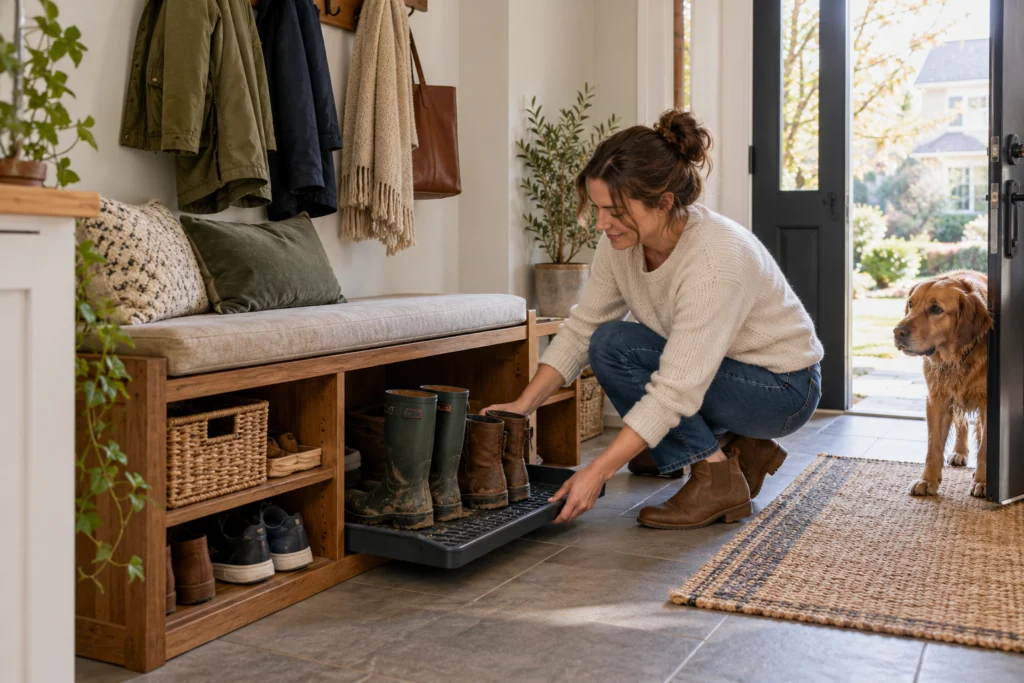
A removable tray beneath wet boots makes cleaning easier, but it needs room to be lifted without tipping water across the floor. Do not pack damp mitts or footwear into a sealed compartment just to make the entrance look tidy.
Use surfaces that can be maintained with the products the maker permits. Check the seat, edge and finish separately if they are different materials. A decorative cushion should be removable for cleaning and should not slide unpredictably during use.
- Test the bench footprint with a chair or taped outline.
- Keep door operation and the route to other rooms clear.
- Plan a reachable home for keys without using the seat as a dumping area.
- Confirm the wall or floor fixing method where stability requires it.
Make the installation understandable
A built-in bench should have a clear support and fixing plan. Do not assume a cabinet designed for storage can safely become seating. Use a product intended for the load or obtain a suitable design from a qualified maker.
Leave a practical way to clean underneath or close the base deliberately. A narrow inaccessible gap becomes a collection point for salt and grit. Label the few compartments that genuinely help people put their own belongings away.
Questions and answers
Does an entry bench have to be built in?
No. A stable freestanding bench can offer a useful trial or a permanent solution. It still needs to suit the space and its intended seating load.
Is closed storage tidier?
Visually it can be, but it should not conceal wet gear or make daily retrieval awkward. Open drying space may be more useful in a busy entrance.
How large should the bench be?
Base the size on the actual doorway, users and clear circulation route. Test the footprint before buying instead of choosing the largest bench that fits against the wall.