Home Guides
Cleaning routines for floors exposed to outdoor grit
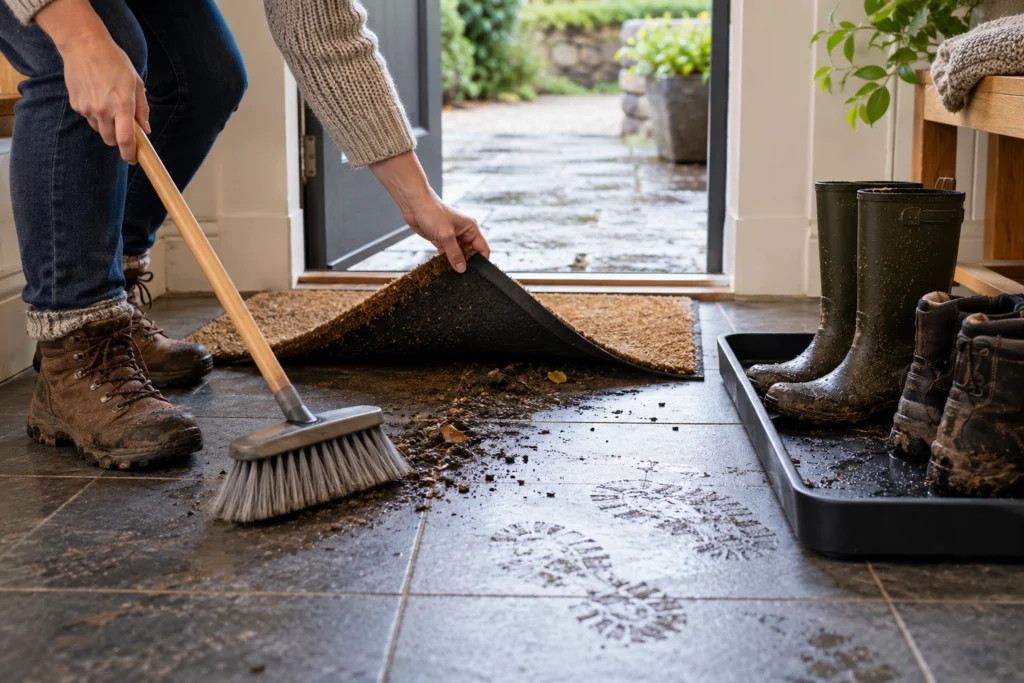
Outdoor grit works its way from an entrance into the rest of a home. The best cleaning routine starts before a wet mop appears: collect loose particles, contain wet footwear and use a method compatible with the specific floor. More water or stronger chemicals are not automatically more effective.
Remove loose dirt before wet cleaning
Use the floor maker’s approved dry-cleaning method, paying attention to corners, mat edges and the area beneath a boot tray. Check that tools are clean and suitable for the surface. A hard piece of debris caught in a pad can be dragged across the finish.
Keep exterior and interior mats maintainable. Shake, vacuum or wash them as their own instructions allow, and let them dry before returning them. A wet mat left in place can hide moisture and dirt underneath.
| Observation | First response | Avoid |
|---|---|---|
| Loose grit | Remove with a suitable dry method | Dragging furniture through the particles |
| Wet footprints | Prompt approved cleanup | Leaving moisture at seams and edges |
| Stuck-on mark | Use the permitted local cleaning method | Unverified solvents or abrasive scraping |
| Recurring dull area | Check residue, wear and tool condition | Adding layer after layer of cleaner |
Use the product instructions as the starting point
Find the exact floor reference and its care guide. Dilution, application and drying requirements differ among products. Do not assume a cleaner advertised for a broad material category is approved for every finish in that category.
Test an approved product only as directed and in a discreet location if the instructions call for it. Keep cleaning products in their labelled containers and away from children and pets. Mixing products can be hazardous and does not improve a routine.
- Give wet boots a defined tray or drying position.
- Clean the area beneath mats rather than only their visible surface.
- Keep separate tools for rough utility areas and delicate interior floors.
- Record a successful approved cleaner so the household uses one consistent method.
Watch for problems cleaning cannot fix
A lifting edge, soft substrate or persistent damp patch needs investigation. Repeated mopping will not correct a leak or an installation defect. Photograph the change and contact the appropriate installer or building professional.
If a floor seems slippery after cleaning, stop using the suspect product and follow the manufacturer’s advice. Residue or an incompatible treatment may be involved. Keep the area safely accessible while the cause is assessed.
Questions and answers
Should I use a steam cleaner?
Only if the specific floor manufacturer permits it. Heat and moisture may be unsuitable for some products or installed assemblies.
Can I remove every mark with stronger cleaner?
No. A mark may be wear, damage or staining that ordinary cleaning cannot reverse. Ask the supplier before using solvents or abrasive products.
How often should I clean an entrance?
Let actual grit and moisture guide the routine. A busy wet day may need prompt attention, while a fixed calendar alone can miss what is happening on the surface.