Home Guides
Stair tread finishes for everyday wear and easy maintenance
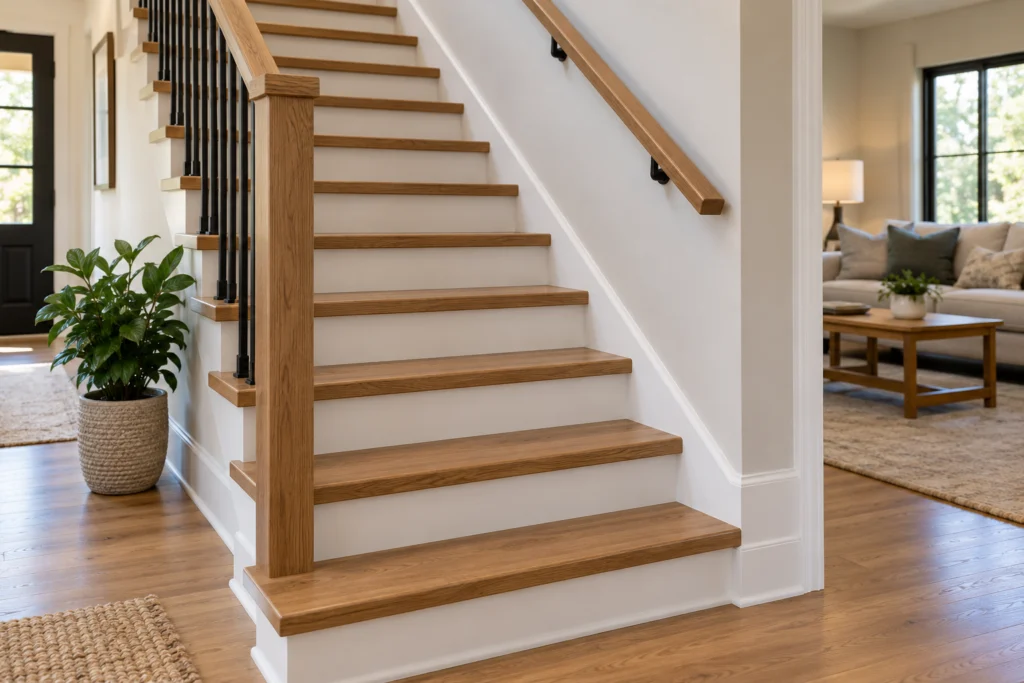
Stairs concentrate wear in a narrow area, and a finish has to be considered with the whole staircase. A good-looking sample is only the beginning. Edges, uniformity, lighting and maintenance affect how the stairs work every day.
Inspect the stairs before choosing a covering
Record loose parts, damaged edges, squeaks and existing coverings. Ask a qualified contractor to investigate structural concerns. Adding a surface over damage can make later repairs harder while leaving the original problem in place.
Changing thickness at a tread or landing can affect the relationship between steps. Do not improvise a stair system from leftover flooring without checking suitability, detailing and applicable requirements with the installer.
| Detail | Useful question | Record |
|---|---|---|
| Leading edge | Which compatible nosing is specified? | Product code and fixing method |
| Surface | How is the finish cleaned and maintained? | Permitted products and routine |
| Consistency | How will the completed stair geometry be checked? | Installer’s scope and assessment |
| Lighting | Are tread edges clearly visible? | Daylight and evening observations |
Consider appearance in use
A very busy pattern can make individual edges harder to distinguish, while highly uniform dark finishes may reveal dust. View samples near the stairs under the lighting normally used at night.
Ask for documented product information where slip performance matters; a hand touching a sample is not a reliable assessment of a stair surface. Loose rugs or improvised tapes can introduce other problems and may be incompatible with the finish.
- Photograph each damaged area before requesting quotations.
- Include landings, nosings, transitions and trim in the scope.
- Ask how the stairs will remain safely accessible during the work.
- Keep cleaning instructions with the final product list.
Make maintenance realistic
Grit should not accumulate where shoes repeatedly load the same edge. Use the approved cleaning method and avoid leaving moisture on the surface. Report a loose tread or nosing promptly rather than treating it as a cosmetic issue.
If family members have changing mobility needs, discuss the staircase as a whole with an appropriate professional. A different surface alone may not address handrails, lighting or the difficulty of using the stairs.
Questions and answers
Can ordinary plank flooring be used on stairs?
Only where the manufacturer and installation system allow it. Compatible nosings, support and fixing details matter; a plank suitable for a room is not automatically a stair solution.
Should I choose the roughest possible texture?
Texture is only one consideration. Cleaning, wear, documented performance and the complete stair arrangement need to be assessed together.
Can I cover one damaged step?
A local repair may be possible, but changes must not create an inconsistent or unsuitable step. Have the underlying damage and completed geometry assessed before proceeding.