Home Guides
What to check when comparing flooring samples
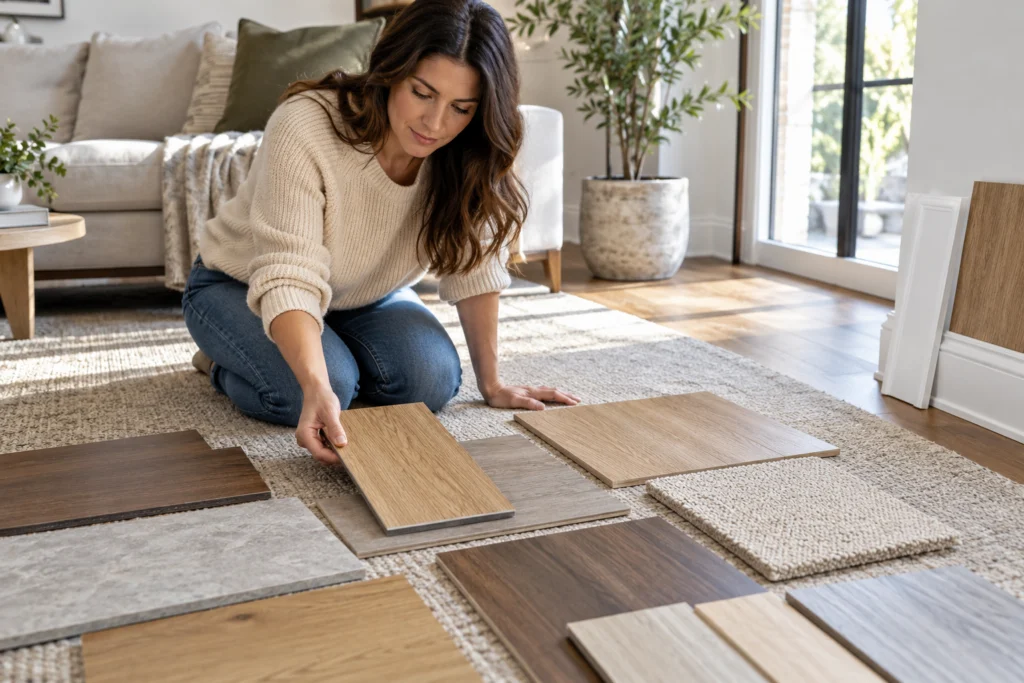
A flooring sample is a useful observation tool, but it is not a miniature warranty or a test of the whole installation. Its job is to help you narrow choices and ask better questions. Bring a shortlist home before committing to a large order.
Look in the room where the floor will be used
Place samples beside existing trim, furniture and adjoining floors. View them in daylight and under the lamps you actually use. A finish that looks warm in a shop can appear cooler beside a particular wall colour.
Look at more than one piece when the design includes pronounced variation. Ask how much variation the manufacturer intends across a full room. Do not assume the single board displayed in the store represents every knot, shade or printed pattern in a delivery.
| Observation | Useful question | Limit |
|---|---|---|
| Colour and sheen | Does it work in this room’s light? | One small piece cannot show a whole-room pattern |
| Surface texture | How does dirt collect and clean? | An unauthorised scratch test proves little |
| Edge profile | What does a joint look like? | A loose sample is not a moisture test |
| Thickness | What floor height should be planned? | Underlay, adhesive and preparation also count |
Bring product documents into the comparison
Record the exact product code with each sample. Similar names can describe different constructions or wear surfaces. Request the current installation, cleaning and warranty documents for that code rather than relying on a generic brochure.
Ask whether a sample comes from the same finish or batch as the material you would receive. If matching existing flooring, make a written note of the proposed transition; a close resemblance in one light is not a promise of an invisible match.
- Label every sample with its product code and supplier.
- View samples flat on the floor, not only held vertically.
- Check the proposed total floor height at doors and thresholds.
- Photograph the shortlist for notes, while judging final colour from the real pieces.
Avoid home-made tests that create false confidence
A coin scratch or a glass of water left overnight may damage a borrowed sample and may not reproduce the installed product’s documented conditions. Ask the supplier which recognised ratings or test information apply to your intended use.
Decide your non-negotiable conditions before selecting the favourite colour. If the room falls outside a product’s stated environmental limits, an attractive sample does not solve that mismatch.
Questions and answers
Should I order from a photograph alone?
A photograph can help build a shortlist but changes with lighting and displays. Real samples and the product documents give a stronger basis for a substantial order.
Why do two pieces of the same floor differ?
Some products deliberately include variation. Ask to see a representative range and clarify what differences are normal before installation starts.
Can a sample confirm the floor will be quiet?
Not by itself. Sound depends on the installed assembly and building. Ask about the specified underlay and any relevant complete-system test information.